Mailmark compliance – what is it and why you need it
If you send large volumes of letters or large letters through Royal Mail, Mailmark isn’t just a technical detail—it’s a competitive advantage. Mailmark is Royal Mail’s modern barcode system that allows mail to be tracked, sorted and reported on with far greater accuracy than older formats.
But to access those benefits, your mailpieces must meet specific design and layout standards. Mailmark compliance ensures your items can be read by Royal Mail’s automated machinery, unlocking lower postage costs and more reliable delivery.
In this article, we’ll explore why Mailmark matters, what it offers your business, and the key design rules you need to follow to stay compliant.
Why Mailmark matters
Mailmark was introduced to modernise the UK’s mail infrastructure. At its core, it’s a machine‑readable barcode, which means that when your mail is Mailmark‑compliant, it can pass through Royal Mail’s automated sorting equipment at high speed, with minimal manual handling. That efficiency is the foundation of the system’s biggest benefit: lower postage costs.
Royal Mail offers discounted rates for Mailmark items because they are cheaper to process. For businesses sending thousands or millions of items a year, those savings add up quickly.
Mailmark also reduces the risk of delays. Because compliant items are designed for automation, they are less likely to be mis‑sorted or damaged. And as Royal Mail continues to upgrade its systems, Mailmark is the format that will remain compatible with future technology. In other words, compliance isn’t just about today—it’s about future‑proofing your mail operations.
What Mailmark compliance involves
Mailmark compliance is primarily about ensuring your mailpiece is designed in a way that Royal Mail’s machines can read. That means paying close attention to the physical format, the address layout, the barcode placement, and the clear zones required for automated processing.
Physical design and envelope construction: Your mailpiece must fall within Royal Mail’s defined size and shape limits. Letters must be rectangular or square with clean 90‑degree corners, and they must meet the required dimensions for height, width, thickness and weight. The material also matters: envelopes must be made from paper of at least 70gsm, and window envelopes must use a flat, secure, low‑gloss film. The item must be flexible enough to bend around a 140mm radius without tearing or creasing excessively. These requirements ensure the item can travel smoothly through high‑speed machinery.
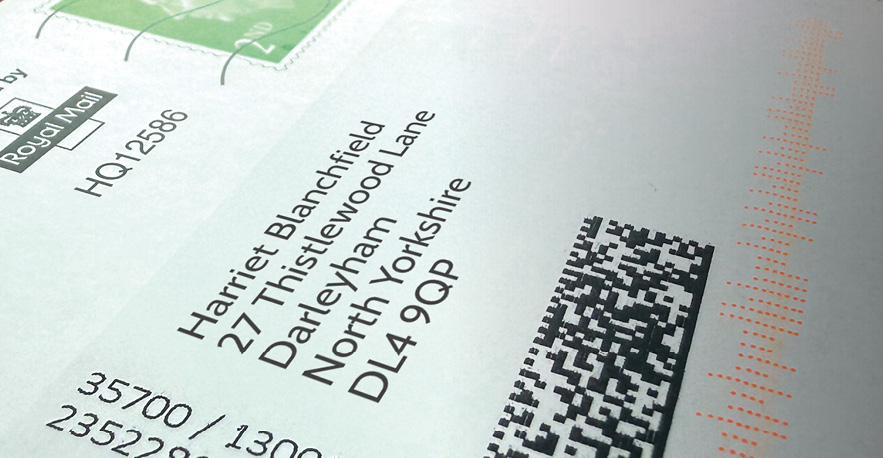
Addressing and print quality: The address is one of the most important elements of Mailmark compliance. Only one delivery address may appear on the item, and it must be printed on the front in the same orientation as the postage mark. Royal Mail requires the address to use an up‑to‑date PAF (Postal Address File) record, with the postcode printed in uppercase on the final line. The text must be clear, dark and printed on a light background, using a font size that is easy for machines to read.
Clear zones around the address are essential. Royal Mail needs space to apply its own orange barcodes during processing, and any artwork, text or graphics in these areas can cause mis‑reads. The bottom of the envelope, in particular, must be kept free of printing so that the route and tag barcodes can be applied without obstruction.
The Mailmark barcode: The Mailmark barcode itself must be printed cleanly, accurately and in the correct position. It must appear on the same side as the address and postage mark, and it must not overlap with any clear zones. The barcode must meet strict print quality standards, including minimum module sizes and quiet zones around the code. These details ensure the barcode can be scanned reliably at speed.
Indicia and postage marks: Your postage mark—whether it’s a PPI or another approved indicia—must be placed in the top‑right corner of the envelope within the defined area. Only one indicia may appear on the item.
Why compliance is worth the effort
Mailmark compliance may seem technical, but the benefits are substantial. You gain access to the lowest available postage rates, and a smoother journey through Royal Mail’s network. You also reduce the risk of surcharges, delays or rejected items—issues that can quickly become costly at scale.
For any organisation that relies on mail, from utilities and financial services to charities and marketing agencies, Mailmark is now the standard. Ensuring your designs meet the requirements is not just about following rules; it’s about maximising efficiency, reducing costs and delivering a better experience for your customers.
Conclusion
Partnering with Cavalier Mailing takes the hassle out of Mailmark compliance. From optimizing physical envelope design and address layouts to ensuring pinpoint barcode printing and zero clear-zone obstructions, our expert mailing services ensure your campaigns meet every single Royal Mail standard seamlessly—delivering maximum postage savings, total reliability, and zero risk of surcharges.