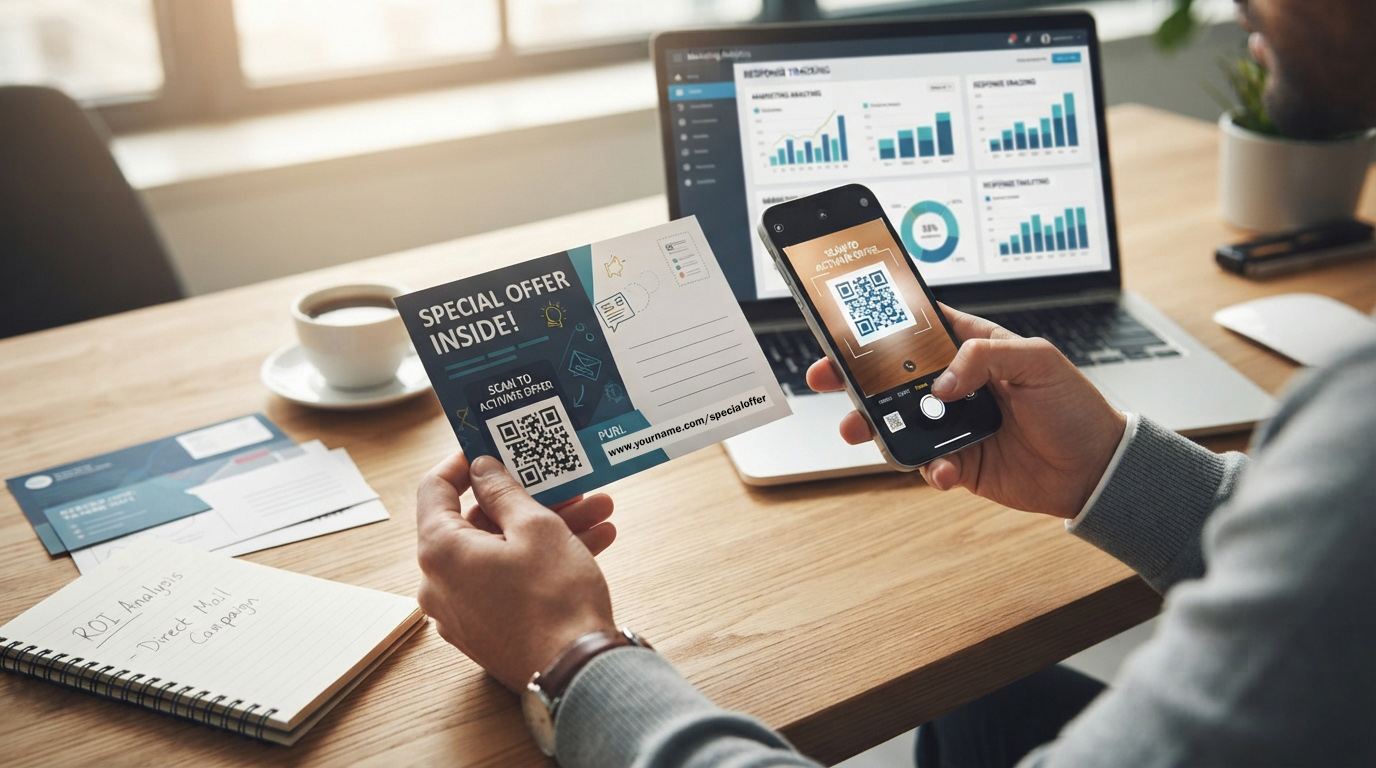
QR Codes, Personal URLs and Response Tracking in Direct Mail
One of the biggest strengths of direct mail is that it can be measured. Unlike many forms of advertising, you know exactly who you’ve sent something to, and with the right tools you can see who responded, when, and what they did next.
But that only works if you build tracking into the campaign from the start. Here’s how QR codes, personalised URLs (PURLs) and a few simpler methods can turn your mailing into a measurable, data-rich channel.
Why track direct mail responses at all?
Without tracking, a campaign is just a spend and a hope. With it, you can:
- Work out your response rate and return on investment
- Compare different offers, formats or audience segments
- Identify which lists and segments perform best
- Feed the results into your next campaign
If you’re also thinking about how to budget for mail, you may find our guide to direct mail ROI useful.
Tracking method 1: QR codes
QR codes have become familiar to almost everyone, and they offer a quick bridge from a printed piece to a digital destination. Scan the code and the recipient lands on a webpage, a form, an app download or a video.
Static vs dynamic codes. A static QR code has its destination permanently built in. A dynamic code points to a short redirect link that you can edit later and that records scans. For campaign tracking, dynamic codes are generally the better choice, as they let you see how many people scanned, when and on what type of device, and you can change the destination if something goes wrong.
Make each code count. If you’re mailing different segments, consider giving each one its own code. That way you can see which segment responded best, rather than getting a single blended figure.
Practical tips for printing QR codes:
- Size and quiet space: Make sure the code is large enough to scan comfortably, with a clear margin of white space around it. A good rule of thumb is to aim for at least 2cm square, and larger if it will be scanned from a distance. [Cavalier to confirm recommended minimum.]
- Contrast: Dark code on a light background scans best. Avoid placing codes over busy images or on glossy stock that reflects light.
- Tell people why to scan: A code on its own gives no reason to act. Add a short line such as “Scan to claim your offer” or “Scan to book your free valuation”.
- Test before printing: Scan a proof on several phones, in different lighting, before the full run goes to print.
- Send people somewhere mobile-friendly: Most scans will be on a phone, so the landing page needs to load quickly and work well on a small screen.
Tracking method 2: Personalised URLs (PURLs)
A PURL is a web address created for an individual recipient, for example yourbrand.co.uk/janesmith, or a short link with a unique code. When someone visits, you can show a page that greets them by name, pre-fills their details and reflects what you already know about them.
Because each address is tied to a specific record in your data, you can see exactly who has visited, even if they don’t complete the form. That makes PURLs particularly useful for higher-value campaigns, where each response matters, and for B2B mailings where follow-up from a sales team is part of the plan.
A unique URL or QR code per recipient is possible with variable data printing, where each piece in a mailing is printed with its own code. It does need careful data and artwork preparation, so it’s one to plan early with your mailing house.
Tracking method 3: Unique codes and vouchers
Not everyone wants to scan or type a web address, and tracking doesn’t have to be high-tech. A unique offer code printed on each piece, which customers quote online, in store or over the phone, allows you to match responses to the original mailing. Vouchers and coupons work in the same way and are especially effective where the aim is to bring people into a shop or showroom.
Tracking method 4: Dedicated phone numbers and URLs
If phone calls are an important response channel, a dedicated tracking phone number used only on that mailing will tell you how many calls came from it. Similarly, a vanity URL used only on the mailing (for instance, yourbrand.co.uk/spring) lets you separate that traffic from your other visitors. Adding campaign tags to the destination link makes it easy to pick up the results in your web analytics.
Tracking method 5: Matchback analysis
Sometimes people don’t use the code, the QR code or the special URL. They simply go online or into a branch and buy. Matchback analysis takes your mailing list and compares it with the people who later made a purchase or enquiry, so you can credit them to the campaign even if they didn’t respond directly.
For this to work, you need a clear record of exactly who was mailed and when, and a consistent way to identify customers in your sales data.
Using a control group
To find out whether the mailing itself made the difference, keep a small group of people who are similar to those you mailed but who don’t receive it. Comparing the two groups shows you the real effect of the campaign rather than just the sales that would have happened anyway.
Don’t forget the data protection side
Tracking involves personal data, so the same principles apply as for the mailing itself. Make sure your privacy notice explains how you use data for marketing and measurement, and that any landing pages comply with the rules on cookies and analytics. If someone asks you to stop marketing to them, make sure that’s reflected in your records so they’re suppressed from future campaigns. Our recent post on direct mail and data protection covers the basics.
It’s also worth remembering that some people are cautious about scanning unfamiliar QR codes. Placing a short, recognisable web address alongside the code, and keeping your branding consistent with the rest of the mailpiece, helps reassure recipients that it’s genuine.
Bringing it together
The most effective campaigns often combine several methods, for example a QR code and a unique offer code on each piece, a dedicated landing page and a matchback exercise afterwards. What matters is that you decide how you’ll measure results before the design is signed off, not once the mail is out of the door.
Talk to Cavalier about tracking your next campaign. From data preparation to variable printing and coding, our team can help you build measurement into your mailing from the start.