The True Cost of Data Hygiene: How Data Decay Quietly Destroys ROI
Paper and postage rates represent a significant proportion of any direct marketing budget. When planning a campaign, teams naturally spend weeks perfecting the creative messaging, selecting the right paper stocks, and refining envelope options.
Yet, one critical factor often gets overlooked until the final invoice arrives: the quality of the underlying database.
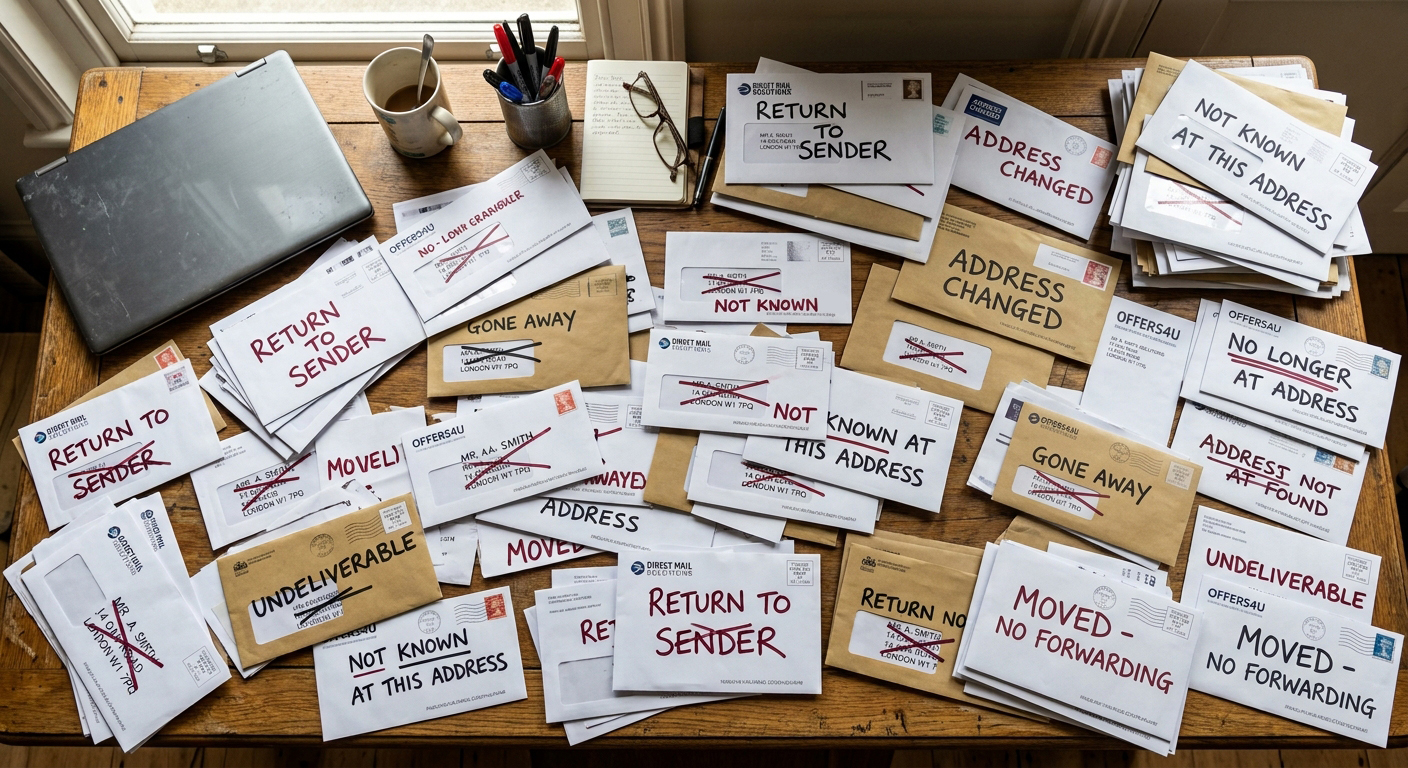
Mailing against an uncleaned or legacy database quietly drains campaign performance. When a mail pack lands on an empty desk or hits a “goneaway” address, the loss goes far beyond a single undelivered envelope—it wastes substrate, machine enclosing time, finishing effects, and postage fees.
Here is a breakdown of how data decay impacts direct mail margins, the external benchmarks every marketer should know, and how rigorous data hygiene turns lost postage into measurable ROI.
The Hard Mathematics of Data Decay
Database decay is not a distant problem; it happens continuously. People change roles, businesses relocate, households move, and life circumstances shift.
Data quality benchmarks across the UK reveal how quickly static lists deteriorate:
- B2B Contact Turnover: Industry benchmarks show B2B data decays at 28% to 30% annually. Job changes, redundancies, acquisitions, and office moves mean nearly a third of a static B2B database becomes inaccurate every 12 months.
- Consumer Relocation: Consumer databases decay at roughly 12% to 15% per year. According to Office for National Statistics (ONS) data, approximately 9.5% of the UK population moves house each year.
The Financial Impact Model
Consider the real-world financial impact on a typical campaign of a 50,000 mailing. With a production and postage cost of £0.65 per item, if 15% (7,500) are bad records, £4,875 is completely lost on unrecoverable print and postage fees.
Worse still is the opportunity cost: those 7,500 wasted packs could have been reallocated toward verified, high-intent prospects, directly increasing the total conversion rate of the drop.
The Core Pillars of Direct Mail Data Hygiene
To protect campaign margins, data hygiene relies on three distinct technical validation processes before artwork goes to press:
- Address Validation via PAD (Postcode Address File)
- Suppression Files (Goneaways & Bereavement)
- Deduplication
Regulatory Compliance & Brand Safety: UK GDPR & MPS
Beyond cost savings, data hygiene is a legal requirement under UK privacy legislation.
- Mailing Preference Service (MPS): UK consumers can register with the MPS to opt out of unsolicited direct mail. Mailing an individual listed on the MPS register breaches industry codes of practice and risks regulatory scrutiny from the Information Commissioner’s Office (ICO).
- Legitimate Interest vs. PECR: While cold digital channels (email and SMS) require explicit opt-in consent under PECR, direct mail operates under Legitimate Interest Assessment (LIA) under UK GDPR. This makes direct mail a flexible acquisition channel for marketers—provided the underlying data is clean, accurate, and lawfully managed.

4-Step Pre-Flight Data Checklist
Before scheduling your next print run, run through this checklist to safeguard your budget:
- Audit Database Age: Identify when key customer or prospect segments were last cleansed. If data has sat untouched for more than 6 months, assume a minimum 7–10% decay rate.
- Run a Pre-Print Data Audit: Screen your database against PAF, NCOA, and MPS suppression files before committing to print volumes.
- Establish Clear Deduplication Rules: Set parameters for match rules depending on the campaign type (individual-level matching for personalised B2C offers vs. company/building-level matching for B2B account-based marketing).
- Close the Feedback Loop: Process returned mail (“Return to Sender” / RTS) immediately to update your master CRM, ensuring inaccurate records are permanently flagged before the next mail drop.
Protecting Your Campaign ROI
Data hygiene is not an added administrative expense—it is an immediate cost-recovery exercise. By scrubbing dead records, correcting postcodes, and suppressing opt-outs before production begins, you ensure every pound spent on print, finishing, and postage delivers maximum impact.